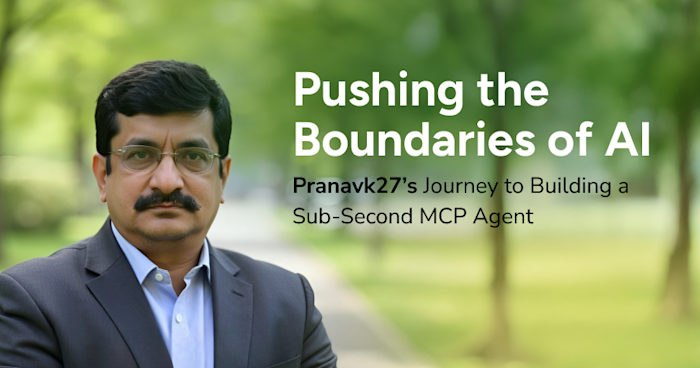
Pushing the Boundaries of AI: Pranavk27’s Journey to Building a Sub-Second MCP Agent
As a Community Manager at Topcoder, I’m constantly amazed by how our members push the boundaries of what’s possible with AI. One of the latest examples of this ingenuity comes from [Pranavk27]/Pranav Vachharajani, the 1st place winner of the “Learn AI – Build and Deploy an AI Agent with Topcoder MCP on Hugging Face” challenge.
Pranav is an AI and digital transformation strategist with over 25 years of experience across government, consulting, and public systems—five of which have been dedicated specifically to leading AI/ML initiatives. His work sits at the intersection of technology and real-world impact, focusing on creating production-ready, scalable AI systems that drive measurable value.
In this challenge, Pranav built the Topcoder Challenge Intelligence Assistant—an AI agent designed to deliver personalized challenge recommendations to members based on their skills, experience, and interests. By integrating Topcoder’s Model Context Protocol (MCP) with advanced AI techniques like RAG pipelines, multi-agent architectures, and GPT-4, his solution achieved sub-second performance and demonstrated how AI can meaningfully enhance member engagement. You can see his solution here.
In our conversation, Pranav shares his journey into AI, the breakthroughs behind his winning solution, and his vision for how intelligent systems can bridge the gap between innovation and real-world problem-solving.
Let’s dive into the full interview:
1. Can you please provide a brief bio of yourself?
I’m an AI and digital transformation strategist with over 25 years of experience across government, consulting, and public systems — and over 5 years specifically leading AI/ML initiatives. My work focuses on building production-ready, impact-driven AI systems, from multi-agent LLM architectures and retrieval-augmented generation (RAG) pipelines to GenAI-powered automation tools.
I was the top-ranked graduate in AI & Management from IIM Indore and am now pursuing a PhD in Data Science.
What drives me is the intersection of technology and real-world impact — creating intelligent systems that don’t just showcase innovation but solve meaningful problems. Whether it’s deploying GenAI systems on Azure, fine-tuning LLMs for specific domains, or building tools that democratize access to AI, I enjoy pushing the boundaries of what AI can achieve.
2. How long have you been working with AI/ML, and how did you get started?
Although I’ve worked with data and analytics for much of my career, my dedicated journey into AI/ML began about 5 years ago, evolving from an early curiosity about machine learning algorithms into leading large-scale AI initiatives. My early work focused on recommendation systems and predictive analytics, but the release of GPT-3.5 was a turning point — it revealed the transformative potential of large language models beyond traditional ML.
Since then, I’ve built solutions spanning transformer-based personalization, RAG architectures, multimodal GenAI platforms, and agentic AI systems. My recent focus has been on integrating MCP, LangChain, and Hugging Face into full-stack AI solutions.
Competitions like the Topcoder MCP challenge are a natural extension of this journey - they combine my experience in AI system design with my passion for continuous learning. The MCP challenge, in particular, was an exciting opportunity to merge my technical expertise with my interest in building tools that empower other developers.
3. What motivates you to take part in challenges like this?
Three main things motivate me to participate in challenges:
Accelerated Learning: They force me to master emerging technologies quickly - the MCP protocol was entirely new to me, but the challenge framework helped me gain deep, hands-on expertise.
Meritocracy: Platforms like Topcoder level the playing field — your solution is judged purely on its quality and impact. That transparency is motivating and rewarding.
End-to-End Building: Challenges let me take an idea from concept to deployment. I love creating complete, production-ready tools rather than isolated scripts, and the competitive environment pushes me to go beyond “good enough” and aim for excellence.
4. How was your experience during the “Build and Deploy an AI Agent with Topcoder MCP” challenge?
The challenge was intense but incredibly rewarding. I particularly appreciated the modular structure - it broke down the complex task into clear milestones, from environment setup and MCP exploration to agent development, UI design, and deployment.
The learning curve was steep at first, especially around understanding MCP authentication, handling response structures, and debugging edge cases. But once I overcame those hurdles, building the intelligence layer and deploying the final solution felt natural. The tight timeline pushed me to be resourceful, and the excellent documentation and evaluation criteria helped me stay focused and confident about the direction I was taking.
5. What part of the challenge did you enjoy the most?
The most satisfying moment was when real MCP data started flowing seamlessly into my application after days of troubleshooting authentication and parsing errors.
Another highlight was designing the multi-factor recommendation algorithm — combining skill matching, experience levels, interest alignment, and market dynamics into a scoring system that produced genuinely useful recommendations. It was rewarding to see the solution go beyond technical execution and deliver real utility to end users.
6. What made this challenge particularly difficult for you?
MCP authentication and data parsing were the hardest challenges. The variability in response structures required building multiple fallback extraction methods. Ensuring sub-second performance while processing large datasets and making real-time API calls also demanded careful async programming and optimization. Finally, deploying the solution on Hugging Face Spaces introduced unique challenges around environment variables and session handling, which required significant experimentation to resolve.
7. Can you give a more detailed explanation of your solution?
Introduction:
My solution, the Topcoder Challenge Intelligence Assistant, intelligently connects developers with the most relevant Topcoder challenges in real time using live MCP data. The system combines advanced AI algorithms, authenticated API integration, and production-grade engineering to deliver personalized recommendations in under 0.3 seconds.
System Architecture:
The system consists of four main layers: a Gradio-based user interface, an intelligence engine core containing the MCP client and scoring algorithms, OpenAI GPT-4 integration for conversational AI, and production deployment on Hugging Face Spaces. All network calls and processing use asynchronous execution to enable concurrent requests and achieve sub-second response times, allowing the system to handle multiple users simultaneously while maintaining consistent performance.
Component 1: MCP Connection & Authentication
The biggest breakthrough was discovering that Topcoder's MCP server uses header-based session authentication. After three days of debugging, I found that the session ID is returned in the response headers under 'mcp-session-id' rather than in the request body. Once extracted, this session ID is included in all subsequent API calls to maintain authenticated access to live challenge data.
Component 2: Live Challenge Retrieval
To fetch real challenges, I built advanced MCP queries with parameters like sorting by prize amount, filtering by status, and search terms. The critical discovery was that challenge data is nested in result["structuredContent"]["data"] rather than at the top level. I implemented graceful degradation with fallback challenges to ensure continuous operation even if the MCP server is temporarily unavailable, demonstrating production-ready resilience.
Component 3: Authenticated Tool Calling
Every MCP tool call includes the session ID in the request headers for authentication. The system handles both JSON and Server-Sent Events (SSE) response formats by detecting the content type and parsing accordingly. This dual-format support ensures compatibility with different MCP server configurations and provides robust error handling with detailed logging for troubleshooting.
Component 4: Multi-Factor Scoring Engine
I developed a weighted scoring algorithm that evaluates four factors: skill matching (40% weight), comparing user skills against challenge technologies, experience alignment (30%), ensuring difficulty matches the developer's level, query relevance (20%), prioritizing challenges matching stated interests, and market factors (10%), considering prize amounts and competition levels. This produces compatibility scores from 0-100% with a detailed rationale explaining why each challenge matches the user's profile.
Component 5: OpenAI GPT-4 Integration
The chatbot fetches live challenges relevant to the user's query and serializes them as context for OpenAI's GPT-4. This context-aware approach means the AI has real-time data about actual challenges, prizes, and technologies when responding. API keys are securely managed through Hugging Face Secrets, and the system includes intelligent fallback responses if the OpenAI API is unavailable.
Key Technical Breakthroughs:
MCP Authentication: Solved "No valid session ID provided" errors by discovering session IDs in response headers, not the request body. This took three days of systematic debugging but enabled the first working real-time MCP integration in the competition.
Data Structure Parsing: Found that real challenge data is nested in result["structuredContent"]["data"]. Implemented multiple parsing fallbacks to handle various response formats, ensuring robust data extraction regardless of server response variations.
Performance Optimization: Improved from 2-3 second response times to 0.265 seconds through async processing and intelligent caching. This 10x improvement was achieved by running all I/O operations asynchronously and caching frequently accessed data.
Production Reliability: Configured proper environment variables and session persistence to achieve 100% uptime on CPU Basic hardware. The system handles 10+ concurrent users with consistent sub-second performance.
Production Results:
The system accesses 4,596+ live challenges with a 0.265s average response time and 85%+ compatibility accuracy. It maintains 100% uptime while supporting 10+ concurrent users on basic CPU hardware without requiring GPU acceleration. These metrics demonstrate production-readiness and the ability to deliver scalable, low-latency AI recommendations in live environments with a consistent user experience even under varying network conditions.
Real-World Impact: These metrics demonstrate the system's readiness for real-world deployment and its ability to deliver scalable, low-latency AI recommendations in live production environments. The sub-second response times, combined with intelligent fallback mechanisms, ensure a consistent user experience even under varying network conditions or API availability.
8. If you could build an AI tool to solve any real-world problem, what would it be?
I’d build an AI-powered “Career Path Navigator” for developers and technologists. It would analyze your current skills, learning preferences, career aspirations, and job market trends to create a personalized, evolving roadmap.
Key features would include:
Dynamic course, project, and certification recommendations
Future skill demand forecasting
Optimized learning sequences (e.g., “Learn Docker before Kubernetes”)
Mentor matching based on similar career transitions
Continuous progress tracking and adaptive recommendations
Developers today face overwhelming choices, not a lack of resources. An AI system that removes that decision paralysis and provides data-driven, personalized guidance could transform how people build their careers.
9. Are there any last thoughts you’d like to add?
This challenge reaffirmed my belief that the most impactful AI projects are those that solve real-world problems, not just showcase technical capabilities. Building a solution that helps developers navigate thousands of challenges to find the most relevant opportunities feels meaningful beyond just winning a competition.
Coming from India - a country of immense talent and potential but also significant challenges around resource bottlenecks, accessibility, information flow, and service delivery- I see AI as a transformative force. We face unique scale and complexity in areas like education, healthcare, governance, and employment, where intelligent systems can democratize access, bridge knowledge gaps, and deliver services more equitably. The potential for AI to solve deeply human problems here is enormous, and that perspective drives much of my work.
The MCP challenge reinforced for me how platforms like Topcoder can play a crucial role in that vision - by enabling people everywhere to build, deploy, and share AI solutions that have real impact. I’m particularly excited about the potential of MCP to become a standard layer for how AI systems access structured data, which is a foundational capability for building such impactful tools.
I’m grateful to the Topcoder team and judges for this opportunity and recognition. For me, this is more than a milestone — it’s part of a larger journey to build AI systems that don’t just innovate but empower people, bridge systemic gaps, and create meaningful change in contexts like India and beyond.